La répression en Russie en 2025 : un système de gouvernance par la peur
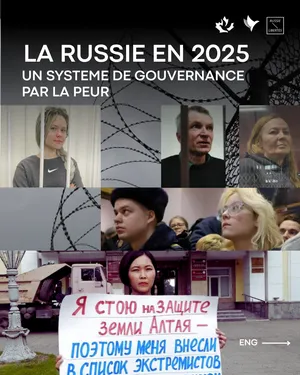
The English version follows below
Criminalisation systématique de la dissidence
En 2025, la répression politique en Russie s’est institutionnalisée comme un outil central de gouvernance . Toute opposition est criminalisée, et les autorités utilisent des poursuites pénales, des peines de prison prolongées, l’intimidation, la torture et les mauvais traitements pour réduire au silence toute critique de la guerre ou du régime.
- 4 686 personnes incarcérées pour des motifs politiques , dont 1 465 en 2025 .
- Des peines de 8 ans en moyenne pour des actes, des mots, des likes sur les réseaux sociaux anti-guerre ou anti-régime.
- Les “appels au terrorisme” sont devenus l’accusation politique la plus fréquente.
- 5 500 affaires administratives pour l’usage de symboles interdits (dont les symboles liés au Fond anti-corruption de Navalny, symboles LGBT, et ukrainiens).
- 1 123 personnes/entités désignées “agents étrangers”.
- 291 ONG classées “indésirables” , toute collaboration avec elles est passible de 6 ans de prison.
Exemple concret : En décembre 2025, trois défenseurs des droits humains d’Ekaterinbourg (Aleksei Sokolov, Larissa Zakharova, Roman Kachanov) ont été arrêtés pour “organisation d’activités d’une organisation indésirable”. Larissa Zakharova et Roman Kachanov risquent jusqu’à 6 ans de prison pour leur coopération avec le Comité Helsinki de Norvège et la National Endowment for Democracy, tous deux désignés “indésirables” en Russie. Aleksei Sokolov, lui, est également poursuivi pour trahison d’Etat, un chef d’accusation passible de 12 à 20 ans de prison.
Utilisation abusive des lois anti-terroristes et anti-espionnage
Les articles du Code pénal sur la trahison , l’ espionnage , et la collaboration avec un État étranger sont devenus des outils de répression massive. Selon Parubets Analytics (décembre 2025) :
- 468 condamnations en 2025 (record absolu), avec une médiane de 15 ans de prison (contre 12 ans en 2024). Dans 35% des cas, les condamnations portent sur des ukrainiens souvent accusés de “collaboration” avec Kiev sur les territoires occupés.
- 4 peines de prison à perpétuité en 2025, et des peines allant jusqu’à 27 ans pour des civils ukrainiens.
- Enfants ciblés : Plus de 350 mineurs inscrits sur les listes d’“extrémistes” ou “terroristes”.
Cas emblématiques :
- Nadine Gueisler , condamnée à 22 ans de prison en juin 2025 pour “trahison” et “terrorisme” après avoir fourni une aide humanitaire à des civils ukrainiens.
- Arina Ivanova (Novokouznetsk), condamnée à 5 ans de prison pour un post sur VKontakte dénonçant les crimes russes à Boutcha.
Torture systématique - Impunité quasi totale.
- Prison SIZO-2 de Taganrog : Un des centres les plus violents, où les détenus subissent famine, passages à tabac, noyades simulées, décharges électriques (y compris sur les parties génitales), viols et humiliations sexualisées.
- Prisonniers ukrainiens : les prisonniers de guerre et civils ukrainiens subissent des violences généralisées. On compte pas moins de 16 000 civils disparus ou détenus illégalement par la Russie (ONU).
Censure numérique et contrôle de l’information
- Blocage massif : Plus de 1,2 million de ressources Internet bloquées en 2025, détruisant l’espace numérique indépendant. * YouTube, Facebook, Instagram, X : Totalement bloqués. * Restrictions sur Apple : Suppression de contenus de médias indépendants et de musiques d’artistes désignés “extrémistes”. * Blocage des appels via Google Meet, FaceTime, WhatsApp, remplacé par la messagerie d’État Max . * Censure normalisée : Autocensure généralisée parmi les artistes, écrivains, blogueurs, et metteurs en scène.
- Loi de juillet 2025 : Criminalisation des recherches en ligne de contenus “extrémistes”.
- Et criminalisation indirecte de l’usage des VPN : l’utilisation d’un VPN/proxy peut être retenue comme circonstance aggravante .
Répression transnationale et pression sur les exilés
Les opposants en exil sont ciblés, et leurs familles en Russie sont harcelées.
- Poursuites contre les opposants en exil : Alexeï Nesterenko, président de Rusos Libres (Espagne), condamné par contumace à 24 ans de prison pour “soutien au terrorisme” après avoir organisé des manifestations anti-guerre et collecté des dons pour l’Ukraine. Sa famille en Russie est harcelée (perquisitions, convocations au tribunal).
- Des pays comme la Turquie extradient des exilés russes vers la Russie sur demande du Kremlin
Torture et “Assauts de viande” dans l’armée russe
Les “Assauts de viande” : Assauts frontaux suicidaires où des soldats (conscrits, prisonniers, contractuels) sont envoyés sans soutien pour épuiser les défenses ukrainiennes. Témoignage :
“On nous a dit : ‘Courez vers les tranchées ukrainiennes. Ceux qui reculeront seront abattus.’ Sur 200, 12 sont revenus.” (source : Verstka).
Les “Trous” : Torture et élimination
- Pratique de l’ “obnoulenie” (“annulation”), où des soldats sont torturés ou tués par leurs supérieurs pour punir, intimider ou éliminer. Des fosses de 2 mètres de profondeur (“trous”) sont utilisées pour noyer ou affamer les victimes. * 12 sites identifiés , avec des dizaines à centaines de victimes par site. À Taganrog, une fosse contenait 47 corps (dont des soldats encore en vie au moment de l’ensevelissement) — témoignage d’un médecin militaire (Rapport “Les Annulateurs” de Verstka). * 1 000+ cas de tortures avérées (rapport ONU). “On jetait les déserteurs dans des fosses avec de la chaux vive. Certains étaient encore en vie.” (Médecin militaire anonyme – Rapport “Les Annulateurs”) .
Autres tortures systématiques
- Passages à tabac, électrocutions (fil sur les parties génitales), noyades, viols collectifs, castrations.
- Exécutions sommaires (balle dans la nuque).
Les prisonniers de guerre ukrainiens sont les premières cibles et subissent des tortures généralisées.
Groupes vulnérables et idéologie d’État
- Violences domestiques : Doublées depuis 2022, souvent commises par des militaires revenus du front. Exemple : En octobre 2025, un soldat russe revenu d’Ukraine a tué sa femme et ses deux enfants à Rostov-sur-le-Don.
- Répression anti-LGBT : Le “mouvement LGBT international” déclaré “extrémiste”. 221 affaires ouvertes pour “propagande LGBT”, y compris pour l’affichage de drapeaux arc-en-ciel.
- Fermeture du Musée du Goulag , retrait des livres de Svetlana Alexievitch des programmes scolaires.
- Loi contre la “propagande childfree” : Interdiction des discussions publiques sur la contraception et l’avortement.
- Idéologie patriarcale : Promue par l’État et l’Église orthodoxe, qui justifie la domination masculine et la soumission des femmes.
- Militarisation de la société : Les valeurs de “virilité” et de “sacrifice” sont exaltées, légitimant les violences contre les femmes et les minorités.
Un climat de terreur généralisée
- Contrôle social total : La surveillance de masse, la censure, et l’autocensure ont créé un climat de peur généralisée.
- Culture et éducation : Condamnations d’artistes (ex. : Evgenia Berkovich et Svetlana Petriichuk, 7 ans de prison pour une pièce de théâtre) et d’enseignants (ex. : Natalia Taranushenko, 7 ans pour avoir évoqué Boutcha en classe).
- Tchétchénie : Climat de peur extrême, marqué par la torture et les exécutions extrajudiciaires.
- Torture et impunité : La torture est généralisée dans les prisons et l’armée, avec une impunité quasi totale pour les auteurs.
Sources :
- Ovd-info
- Memo pzk
- Amnesty International
- Parubets Analytics
- Rapport ONU
- VERSTKA : Torture dans l’armée
- EUAA Country Focus Report (novembre 2025)
- The Insider : “Meat Assaults” (2025)
English version :
Repression in Russia in 2025: a system of governance through fear
Systematic criminalization of dissent
In 2025, political repression in Russia has become fully institutionalized as a central tool of governance. Any form of opposition is criminalized, and the authorities use criminal prosecutions, long prison sentences, intimidation, torture, and ill-treatment to silence any criticism of the war or the regime.
- 4,686 people imprisoned for political reasons (Memorial), including 1,465 in 2025 alone .
- Average sentences of 8 years for actions, words, or even likes on social media expressing anti-war or anti-regime views.
- “Calls to terrorism” have become the most common political charge.
- 5,500 administrative cases for the use of prohibited symbols (including symbols linked to Navalny’s Anti-Corruption Foundation, LGBT symbols, and Ukrainian symbols).
- 1,123 individuals/entities designated as “foreign agents.”
- 291 NGOs classified as “undesirable”; any cooperation with them is punishable by up to 6 years in prison .
Concrete example:
In December 2025, three human rights defenders from Yekaterinburg (Aleksei Sokolov, Larissa Zakharova, Roman Kachanov) were arrested for “organizing the activities of an undesirable organization.” Larissa Zakharova and Roman Kachanov face up to 6 years in prison for cooperating with the Norwegian Helsinki Committee and the National Endowment for Democracy, both designated “undesirable” in Russia. Aleksei Sokolov is also charged with high treason , an offense punishable by 12 to 20 years in prison .
Abuse of anti-terrorism and anti-espionage laws
Articles of the Criminal Code on treason, espionage, and cooperation with a foreign state have become tools of mass repression. According to Parubets Analytics (December 2025):
- 468 convictions in 2025 (an all-time record), with a median sentence of 15 years (up from 12 years in 2024).
- In 35% of cases , those convicted are Ukrainians, often accused of “collaboration” with Kyiv in occupied territories.
- 4 life sentences in 2025, and prison terms of up to 27 years for Ukrainian civilians.
Children targeted:
More than 350 minors have been placed on lists of “extremists” or “terrorists.”
Emblematic cases:
- Nadine Gueisler , sentenced to 22 years in prison in June 2025 for “treason” and “terrorism” after providing humanitarian aid to Ukrainian civilians.
- Arina Ivanova (Novokuznetsk), sentenced to 5 years in prison for a VKontakte post denouncing Russian crimes in Bucha.
Systematic torture – near-total impunity
SIZO-2 prison in Taganrog:
One of the most violent detention centers, where prisoners are subjected to starvation, beatings, simulated drowning, electric shocks (including to the genitals), rape, and sexualized humiliation.
Ukrainian prisoners:
Prisoners of war and Ukrainian civilians are subjected to widespread violence. At least 16,000 civilians are reported missing or illegally detained by Russia (UN).
Digital censorship and control of information
- Mass blocking: Over 1.2 million online resources blocked in 2025, destroying the independent digital space.
- YouTube, Facebook, Instagram, X: Completely blocked.
- Restrictions on Apple: Removal of content from independent media and music by artists designated as “extremists.”
- Blocking of calls via Google Meet, FaceTime, WhatsApp, replaced by the state messaging service Max .
- Normalized censorship: Widespread self-censorship among artists, writers, bloggers, and theater directors.
- July 2025 law: Criminalization of online searches for “extremist” content.
- Indirect criminalization of VPN use: The use of a VPN/proxy can be treated as an aggravating circumstance.
Transnational repression and pressure on exiles
Opponents in exile are targeted, and their families in Russia are harassed.
- Prosecutions in absentia: Alexei Nesterenko , president of Rusos Libres (Spain), was sentenced in absentia to 24 years in prison for “supporting terrorism” after organizing anti-war demonstrations and collecting donations for Ukraine. His family in Russia is harassed (searches, court summons).
- Extraditions: Countries such as Turkey extradite Russian exiles to Russia at the Kremlin’s request.
Torture and “meat assaults” in the Russian army
“Meat assaults”:
Suicidal frontal attacks in which soldiers (conscripts, prisoners, contract soldiers) are sent without support to exhaust Ukrainian defenses. Testimony:
“We were told: ‘Run toward the Ukrainian trenches. Those who retreat will be shot.’ Out of 200, 12 returned.” (source: Verstka)
“The pits”: torture and elimination
The practice of “obnulenie” (“nullification”), where soldiers are tortured or killed by their superiors to punish, intimidate, or eliminate them. Two-meter-deep pits (“holes”) are used to drown or starve victims.
- 12 identified sites , with dozens to hundreds of victims per site.
- In Taganrog, one pit contained 47 bodies (some soldiers were still alive when buried) — testimony of a military doctor (Verstka report “The Nullifiers” ).
- 1,000+ documented cases of torture (UN report).
“They threw deserters into pits with quicklime. Some were still alive.”
(Anonymous military doctor – Verstka report “The Nullifiers”)
Other systematic abuses:
Beatings, electrocution (wires on genitals), drowning, gang rape, castration.
Summary executions (shot in the back of the head).
Ukrainian prisoners of war suffer torture systematically.
Vulnerable groups and state ideology
- Domestic violence: Doubled since 2022, often committed by soldiers returning from the front. Example: In October 2025, a Russian soldier back from Ukraine killed his wife and two children in Rostov-on-Don.
- Anti-LGBT repression: The “international LGBT movement” declared “extremist.” 221 cases opened for “LGBT propaganda,” including for displaying rainbow flags.
- Closure of the Gulag Museum , removal of Svetlana Alexievich’s books from school curricula.
- Law against “childfree propaganda”: Ban on public discussions of contraception and abortion.
- Patriarchal ideology: Promoted by the state and the Orthodox Church, justifying male dominance and women’s submission.
- Militarization of society: Values of “virility” and “sacrifice” are glorified, legitimizing violence against women and minorities.
A climate of generalized terror
- Total social control: Mass surveillance, censorship, and self-censorship have created a pervasive climate of fear.
- Culture and education: Convictions of artists (e.g. Evgenia Berkovich and Svetlana Petriichuk , 7 years in prison for a theater play) and teachers (e.g. Natalia Taranushenko , 7 years for mentioning Bucha in class).
- Chechnya: An extreme climate of fear marked by torture and extrajudicial executions.
- Torture and impunity: Torture is widespread in prisons and the army, with near-total impunity for perpetrators.